Wednesday, December 14, 2011

OMOSEYE BOLAJI By Hector Kunene


Review by Rebaone Motsalane


Book: Omoseye Bolaji
Author (Editor): Hector Kunene

After reviewing many of his books, the spotlight was finally put on him not as a writer but unmasking the persona behind countless books penned by him.

“Omoseye Bolaji” is a book by Hector Kunene. This is reportedly a biography on Bolaji and Kunene makes a great attempt to unmask the international literary giant. What an honour!

I promised Bolaji that I would not review this (book), but after reading it, I could not shut up and I was impressed and touched by the findings even though they were limited.

These are some of Hector’s discoveries about Omoseye Bolaji. He is (was?) painfully shy, a rare character in this loud world where most extroverts confuse being air heads with being confident. He also experienced a great share (deal) of troubles which might be the reason he is sensitive to the world.

Kunene also noted some of Bolaji’s personal achievements but his subject did try to downplay them. I also got the sense that Kunene knew more than what he has penned down, and out of respect for the “master”, honoured a promise not to reveal him completely to the world. For this, the writer is a bigger (better) man compared to me!

It was good to find out what makes Omoseye Bolaji what he is today. He is shy, humble, ordinary and likes to be considered as nothing special, though he has got so much to be proud of.

I believe these characteristics are just an act to mask the truth behind this enigma. In fact he is a very intelligent person who likes to downplay his abilities so that people around him feel comfortable.

I believe these characteristics are just an act to mask the truth behind this enigma. In fact he is a very intelligent person who likes to downplay his abilities so that people around him feel comfortable. He is confident but hides behind his shades (literally) in case people discover the truth and want a piece of him. He is also very empathetic.

* This review first published in Mangaung Issue, December 14, 2011 edition

Saturday, November 19, 2011

FS LITERATURE 2011: A Review


By PAUL LOTHANE

Is it too early to reflect on how literature fared in the FS this year (2011)? Probably not. After all, those of us who like to claim we love the art of creative writing and all that goes with it can scent the trends quite distinctly.

And one thing is clear: 2011 can hardly hold a candle to 2010 (last year) which was an exciting year in the annals of the so-called renaissance of Black Writing in the Free State. Everything seemed to come together in 2010 – exciting new writers publishing their books, literary-critical articles of the highest order, reviews unlimited.

How many times do we have to say it that writers must ensure that their books are read by the right people, respected reviewers critics, even scholars if possible? In this way they (writers) are assured of some sort of immortality with their books being analysed, talked about, reviewed. As history has shown, those who do not go through this process are either wasting their time, writing only for themselves, or will never really be acknowledged as writers.

The same 2010 we saw two, three wonderful examples of this in the FS. Hector Kunene and Nthabiseng JahRose Jafta attained the type of literary fame most new writers can ever dream about. Their books were properly analysed and discussed in national publications, and on the internet for the whole world. A researcher or any interested reader anywhere in the world, in any country, can check their progress on the internet now, and be impressed.

That is what literature is all about, focusing on the books, ideas, criticism, comments etc. To a certain extent the same was also true for NMM Duman whose apparently reclusive nature has not stopped the world from appreciating her literary genius. Teboho Masakala also hit the scene with his first book in 2010 (short stories)

So, what about the pick of the books published in 2011? One can hardly do any better than first appreciate O Bolaji's Miscellaneous Writings. Whether his career as a writer of fiction is over or not, his book Miscellaneous Writings oozes quality with excellent short essays and stories. Not only does Bolaji write about international and African writers, he does a great service nearer home here by also focusing on the literary work of the likes of Sheila Khala, NMM Duman and Teboho Masakala

Teboho Masakala second book, Through it all also came out this year. A novella, the author has been clever enough from a very young age to realise the importance of reviewers and critics. Hence his book has received appreciable attention by some literary experts. Sechaba Marumo also published a motivational book.

After an absence of some years Thabo Mafike must also be commended for publishing two new books late this year, I have just learnt. It is a bit too early to comment on his works, as they are hardly in the market…the danger, as one has pointed out earlier is the fact that so many of these publications are never really reviewed or analysed by those who know their onions. I am also happy that Charles Matorera published his delightful "long short story", Singwizi the golden journey late this year.

The most disappointing aspect of 2011 was the failure of the much advertised book on Flaxman Qoopane, supposed to be written by Hector Kunene, to come out. Thus far, no apology or explanation has been offered to the literary world to explain such a farce and embarrassment. Writers, even those from F.S must remember that the literary world is a very serious, responsible one where reputations can be made and tarnished quite easily. There are many scrupulous and focused people out there who frown on what the world would perceive as dishonesty or a lack of purpose.

One or two other positive items that ensured that 2011 will at least get a pass mark (apart from the few book publications). The celebrated international scholar and researcher, Achal Prabhala visited the Free State this year and his write-up on literary developments has now been published in the Chimurenga journal, and widely on the internet. A controversial piece, as one would expect from any genuine scholar, perhaps the main defect of it was the failure of Mr Prabhala to mention more than just a very few key FS writers.

Happily enough the other major general write-up of the year, “A harvest of Free State poetry” does not suffer from this defect. Written by O Bolaji, the article is a breathtaking, authoritative manner traces the genesis of poetry writing and publication at grassroots level in the FS, and mentions over 20 of such outstanding writers! It is no surprise that the article is now being reproduced on many international websites, and is being used for research and scholarly purposes around the world.

Let me end here by expressing the hope that the year 2012 will at least sustain the progress being made in the FS literary field, with an emphasis on quality books.

Monday, October 3, 2011

The New Interpreters?


By Paul Lothane


Books, specifically works of fiction, have their special allure and
can be forever. For example when millions of people worldwide think of
Mark Twain, their minds immediately go to his work, Huckleberry Finn.

In Africa here a book doesn’t come more popular than Achebe's Things
fall apart. Tsitsi’s Nervous Conditions seems to have assumed a life
of its own too. Such is the attraction, and importance of works of
fiction.

Many a time as readers, a book reminds one of of others, whether in reality there are links or not. Reading this new book, A series of undesirable events, my mind kept on going to Wole Soyinka s novel, The interpreters. In this wonderful work, Soyinka creates a group of young artists and
intellectuals.

They include Egbo, the young aristocrat, Sekoni, the engineer turned sculpture Sagoe the journalist, Bamidele the lawyer, Kola the art teacher, etc. Their intellect lights up this book.

In Skade’s new book, we also have a group of such people - Tumi, the lawyer, Tshitso, the photographer, Sechaba, a popular fine artist, Moshe, Kgotso the
graphic artist...

Not to forget the ill-fated lady, Pulane. “Pulane had not followed through on her high school dream of becoming a doctor. Her fear of blood was too all consuming for her to continue along that path. She changed to working with charity organizations after her Communication Science honours degree,"

So here we have a group of intelligent well educated people, no doubt initially very confident and happy before things begin to fall apart. That art is very important to them is clear enough, eg Thabo and his passion for jazz.

I feel the following passage says it all:

“Art has always been a critical aspect in resistance movements wherever there has been oppression, where the masses had been deprived of dignity and subjugated and killed, art was their lifeblood - a restoration of their spirits. Art shouts the loudest. The law was often inspired to change through art. “ (Page 79.)

This work is an impressive, skilful debut. Just like in The Interpreters, there is a lot of despair and unhappy episodes. In Deon Simphiwe Skade's A series of Undesirable Events it does seem too contrived and unrealistic.

Wednesday, September 21, 2011

Tsietsi e latella tshotleho. By J.J MOILOA

Book: Tsietsi e latella tshotleho
Author: J.J Moiloa
Review by Rebaone Motsalane


What I love to hate about experienced and gifted writers is their ability to grab my attention until the end of the book, though sometimes it requires a lot of patience to do so.

I had to read until page 53 to get to the essence of the story and only then the plot of the story was revealed. I was half-way through and about to finish and still not sure about the storyline.

The story picks up very slowly and the only thing that kept my attention is the background of the writer as he is highly esteemed and respected.

At the end, my curiosity paid off and over-powered the frustration of trying to figure the storyline out. It was beautifully written and revealed.

The book is about a man who clearly is not in his right mind and highly agitated. However at the beginning the story is not clear about the cause and his motives. He has a plan which the reader is not clear about, whether it is to rob a mine or something else. At the beginning I thought he was there to enrich himself, only to find out that he was there to avenge his wife’s rape which resulted in a son that he hated so much.

He lays a trap to stage an incident and blow up the culprit and to finally put matters to rest and go back home. True, the accident happened where not only his enemy got injured, but two other innocent men who knew nothing about the hatred between the two.

When they all thought that they will never be rescued, he confessed to his friend how he stole explosives to cause the accident and apologises to his friend. He takes the blame and at the same time relives his pain and suffering that got him there; he unloads his frustrations.

However, a sting remains in the tail…

Wednesday, August 3, 2011

THE CREST: Omoseye Bolaji honoured in Nigeria


THE CREST: By Flaxman Qoopane
Reviewer: Rebaone Motsalane


Flaxman Qoopane got me again, so to speak! He is one writer who time and again stretches his talent and comes up with something totally different and unpredictable. He can do novels, poetry, drama and any other genre of writing.

As witness the time he took all his correspondence and turned it into a book. How does he come up with such ideas?

As a result of this, I fail, perhaps when classifying his books, and I cannot put him into a box. “The Crest” is about a friend of his, Omoseye Bolaji, who was honoured outside South Africa (in Nigeria) and he (Qoopane) was invited as one of the guests of honour to make a speech and celebrate the giant steps they have taken together in the literary world.

He cleverly takes the reader through the whole process, starting with the duo being invited to this world class event until Bolaji makes the acceptance speech which he termed “The Crest”.

Indeed it is a sort of “crest”, as one writer takes his time and resources to write about the success of another writer without a sense of jealousy or a need for recognition; but just paying tribute to him in his lifetime.

This is not very common, as before embarking on such a big project you have to evaluate your readership very carefully. Who would want to praise another writer to high heavens? At least if it was a biographer then it could be justified.

On the positive side, I guess being an established writer (Qoopane), you can more or less get away with anything because you already enjoy a remarkable support base and it would not be so hard to convince avid readers about your credibility - as they are already familiar with your writing.

Yet again, Qoopane raises the bar higher and gives aspiring writers a run for their money in this industry. He is indeed on top of his game. Indeed it is a Crest!

The book is available at (Free State) local libraries…

Saturday, July 9, 2011

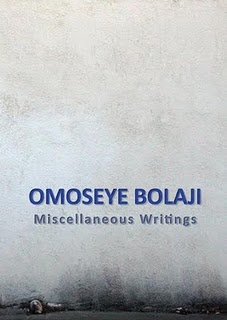
MISCELLANEOUS WRITINGS. By Omoseye Bolaji


Review by Leke Giwa


I suppose it was too good to be true; Omoseye Bolaji's new book is not
fiction; certainly not another new instalment of the "Tebogo Mokoena
Mystery series".

Remember, recently for three years consecutively, Bolaji churnned out
three adventures of our beloved Tebogo: Tebogo and the haka (2008),
Tebogo and the epithalamion (2009), and Tebogo and the pantophagist
(2010). When will the next adventure come out?

Or, will we ever read another new Tebogo adventure? This might sound
ominous and churlish, but we know that creators/authors of such
memorable characters invariably put an end to the advenures of their
own protagonists; like Dorothy Sayers, Agatha Christie, even James
Hadley Chase did.

No matter. We should also remember that Omoseye Bolaji has many
strings to his bow, apart from writing fiction; having published lots
of poetry, criticism, biographies, and plays. This latest offering,
Miscellaneous Writings (2011) are more in the line of short essays and articles.

Some might be tempted - perhaps rather cruelly - to state that this
new work is neither fish nor fowl. Certainly the writings here can
roughly be dubbed "essays", but differ in structure, quality, depth,
moods, thrust, and approach.

It seems to me that that is why the title of the new book is so apt,
apposite - Miscellaneous Writings. There is a strong bias towards
literature and the world of letters in general; but we also have germs
of world history, social matters, philosophy, sports etc.

These things are subjective, and I did read many of the pieces here in
the new book when they first came out intermittently in the form of the author's
column(s). Strangely enough, my personal favourites among these essays
are "bizarre" ones like "The vagaries of poverty" "NELM in
Grahamstown" Sheila Khala (the Lesotho poet), The Guitarists, and
Allure of Father Xmas"

I always ask myself: have I benefitted, gained by taking the trouble
to read a particular book? If the answer is yes, then the effort has
been worthwhile, and the book in question for me) makes a valuable
contribution to one's life, knowledge, society, country and beyond.
I'm happy to recommend Omoseye Bolaji's new book - Miscellaneous
Writings - for the world to read.

Wednesday, June 29, 2011

MOLEBOGENG ALITTA MOKHUOA. By Omoseye Bolaji

Review by Rebaone

If it was not in honour of the late author (M.A Mokhuoa), I would not have chosen another one of Omoseye Bolaji’s books. He certainly dominates and over-shadows Free State (Black) writers. I don’t know if it is because of a lack of marketing from others, or simply that more still needs to be done to have more writers on the Free State block.

I felt obliged to review this one in memory of Molebogeng Alitta Mokhuoa. The book is in two parts: the first about the lady herself, and the second about her writings. This I believe was a great move for readers like me did not know her, save for the fact that she made a valuable contribution in promoting literature in the province.

She was even crowned Author of the Year in 2002. I never met her personally so it’s difficult to ascertain how Bolaji described her personality and work, but if her writings in the latter part of the book are anything to go by, clearly she would have made and achieved great strides in the world of books.

The book is a good read for anyone who knew her, and might also appeal to aspirant writers who wish to know more about the landscape of Free State writers.

Bolaji also cleverly used this opportunity to refer to other books under his name, and that of other writers, either to market them or to showcase Mokhuoa’s knowledge of literature. He regards her opinion highly and apparently respected her ordinary way of life and writing style.

He described her as the one who would go for short stories by choice and not waste time “going big”. This might sound as if he is putting her in a box, but on the other hand it indicates that she knew what she wanted and how to get it.

Bolaji has so far enjoyed great space, and by reviewing this one, a shortage of Free State writers has again been indicated; especially female ones. Where are they?
* First published in Mangaung Issue, 29 June 2011 edition